
Zeus facts for kids
Quick facts for kids Zeus |
|
|---|---|
| God of the sky, lightning, thunder, law, order, and justice | |

Zeus de Smyrne, discovered in Smyrna in 1680
|
|
| Abode | Mount Olympus |
| Symbol | Thunderbolt, eagle, bull, and oak |
| Personal information | |
| Consort | Hera and various others |
| Children | Aeacus, Agdistis, Angelos, Apollo, Ares, Artemis, Athena, Dionysus, Eileithyia, Enyo, Epaphus Eris, Ersa, Hebe, Helen of Troy, Hephaestus, Heracles, Hermes, Lacedaemon Minos, Pandia, Persephone, Perseus, Rhadamanthus, the Graces, the Horae, the Litae, the Muses, the Moirai |
| Parents | Cronus and Rhea |
| Siblings | Hestia, Hades, Hera, Poseidon, Demeter, Chiron |
| Roman equivalent | Jupiter |
| Norse equivalent | Thor or Odin |
| Slavic equivalent | Perun |
Zeus is the most powerful god in Greek mythology. He is known as the god of the sky, lightning, and thunder. Zeus rules over all the other gods on Mount Olympus.
Zeus was highly respected throughout Ancient Greece. The ancient Olympic Games were held every four years to honor him. Zeus was known for his strong temper and his powerful weapon: the thunderbolt. It was said to be the strongest weapon among all the gods.
He was also known for throwing thunderbolts at people. As the god of honor and justice, Zeus created and upheld laws. He was a role model for kings, making sure they used their power wisely. In Norse myths, he is similar to Odin.
Contents
Birth and Childhood
Zeus was the sixth child of Cronus and Rhea, who were the king and queen of the Titans. Cronus learned from a prophecy that one of his own children would overthrow him, just as he had overthrown his own father. To prevent this, Cronus swallowed each of his children as soon as they were born. He swallowed Hestia, Demeter, Hera, Hades, and Poseidon.
When Zeus was born, his mother Rhea wanted to save him. She asked her parents, Gaia and Uranus, for help. Following their advice, she went to the island of Crete to give birth. She hid baby Zeus in a cave on Mount Ida. Instead of giving the baby to Cronus, she gave him a stone wrapped in baby clothes. Cronus swallowed the stone, thinking it was his son.
Zeus grew up in the cave, looked after by nymphs. Myths say he was fed milk from a magical goat named Amalthea. To hide his crying from Cronus, a group of warriors called the Kouretes danced outside the cave, clashing their spears against their shields to make a loud noise.
Rise to Power


When Zeus grew up, he was ready to challenge his father. With the help of the goddess Metis, he gave Cronus a special potion. This made Cronus throw up the stone and the five children he had swallowed. Zeus's siblings—Hestia, Demeter, Hera, Hades, and Poseidon—were alive and fully grown.
Together, they started a great war against the Titans called the Titanomachy. Zeus freed the Cyclopes (giants with one eye) from prison. In return, the Cyclopes made powerful weapons for the gods. They gave Zeus his famous thunderbolt, Poseidon a trident, and Hades a helmet of invisibility.
The war lasted for ten years. Finally, Zeus released the Hecatoncheires (giants with a hundred hands) to help him. They threw huge rocks at the Titans while Zeus threw his lightning bolts. The Titans were defeated and locked away in Tartarus, a deep pit in the underworld.
After the war, Zeus and his brothers divided the world among themselves. They drew lots to decide who would rule what:
- Zeus became the King of the Gods and ruler of the sky.
- Poseidon became the ruler of the seas.
- Hades became the ruler of the underworld.
The earth and Mount Olympus were shared by all of them.
Battles with Giants and Monsters
Even after becoming king, Zeus had to defend his throne. The earth goddess Gaia was angry that her children, the Titans, were imprisoned. She sent a race of powerful Giants to attack the gods. This war was called the Gigantomachy. The gods needed the help of a mortal hero to win, so Zeus called upon his son Heracles. Together, they defeated the Giants.
Later, Gaia sent a terrifying monster named Typhon to fight Zeus. Typhon was a giant creature with a hundred snake heads that breathed fire. Zeus fought Typhon in a fierce battle that shook the earth. Eventually, Zeus trapped Typhon under Mount Etna, a volcano in Sicily.
Symbols
Zeus is easily recognized in art and stories by his symbols:
- Thunderbolt: His most powerful weapon, used to strike enemies or show his anger.
- Eagle: A symbol of strength and power. The eagle was his sacred bird.
- Aegis: A magical shield or breastplate that could cause fear in enemies.
- Oak Tree: His sacred tree. Priests at Dodona would listen to the rustling leaves of oak trees to hear Zeus's messages.
Family
_-_Napoli_MAN_9559_-_01.jpg)
Zeus married his sister, Hera. She became the Queen of Heaven. Their wedding was a grand event attended by all the gods. Gaia gave them a tree with golden apples as a wedding gift. Together, Zeus and Hera had children, including Ares (the god of war), Hebe (the goddess of youth), and Hephaestus (the god of fire and crafts).
However, Zeus and Hera often argued. Zeus was famous for falling in love with many other goddesses and mortal women. This made Hera very jealous. To hide from Hera or to approach women he liked, Zeus would often use his power to change his shape.
- He became a bull to carry the princess Europa to Crete.
- He appeared as a swan to Leda.
- He turned into an eagle to take the young prince Ganymede up to Olympus to be the cupbearer of the gods.

Children of Zeus
Zeus was the father of many important figures in Greek mythology.
- With Goddesses:
- Athena: Born from Zeus's head after he swallowed her mother, Metis. She is the goddess of wisdom and war strategy.
- Apollo and Artemis: Twins born to Leto. Apollo is the god of the sun and music; Artemis is the goddess of the hunt.
- Hermes: The messenger god, born to the nymph Maia.
- Persephone: The queen of the underworld, daughter of Demeter.
- The Muses: Nine goddesses of the arts and sciences, daughters of Mnemosyne.
- With Mortals:
Zeus and Humans

Prometheus and Fire
Zeus had a complicated relationship with humans. The Titan Prometheus liked humans and wanted to help them. At a feast, Prometheus tricked Zeus into choosing a pile of bones covered in fat as a sacrifice, leaving the good meat for the humans. Zeus was angry and took fire away from humanity as punishment.
Prometheus stole fire back from Mount Olympus and gave it to humans. Furious, Zeus punished Prometheus by chaining him to a rock. He also sent the first woman, Pandora, to earth with a jar (often called a box). When Pandora opened the jar, all the evils of the world flew out, leaving only "Hope" inside.
The Great Flood
Later, Zeus became disappointed with how wicked humans were behaving. He decided to wipe them out with a Great Flood. With the help of Poseidon, he flooded the world. Only two good people, Deucalion and Pyrrha, survived by building a chest (like an ark). After the waters went down, they repopulated the earth.
The Trojan War
In the epic poem the Iliad by Homer, Zeus plays a major role in the Trojan War. He tries to stay neutral but often has to intervene. He weighs the fates of heroes on his golden scales to decide who will win or lose. Even though he loved his son Sarpedon, he had to let him die in battle because it was his destiny.
Interesting facts about Zeus
- The name "Zeus" comes from an ancient word meaning "sky" or "shine."
- People in ancient Greece respected Zeus as a father figure. Even gods who were not his children called him "Father."
- Zeus was often identified with gods from other cultures. The Roman god Jupiter is his most famous equivalent. He was also linked to the Egyptian god Ammon and the Etruscan god Tinia.
- The most famous festival for Zeus was the Olympic Games, held every four years in Olympia.
- In the temple at Olympia, there was a huge statue of Zeus made of gold and ivory. It was created by the sculptor Phidias and was considered one of the Seven Wonders of the Ancient World.
- The famous winged horse Pegasus was said to carry Zeus's thunderbolts.
- Zeus is mentioned a couple of times in the New Testament. For example, in Acts 14:8–13, people in Lystra thought the Apostle Paul and his partner Barnabas were gods. They identified Paul with Hermes and Barnabas with Zeus.
Related pages
- Tinia - The Etruscan mythology version of Zeus.
- Odin - The Norse mythology version of Zeus.
- Jupiter - The Roman mythology version of Zeus.
Images for kids
-
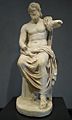
Zeus, at the Getty Villa, A.D. 1 – 100 by unknown.
-
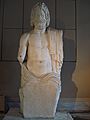
Colossal seated Marnas from Gaza portrayed in the style of Zeus. Roman period Marnas was the chief divinity of Gaza (Istanbul Archaeology Museum).
-
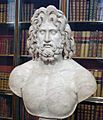
Roman marble colossal head of Zeus, 2nd century AD (British Museum)
-
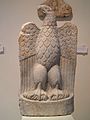
Marble eagle from the sanctuary of Zeus Hypsistos, Archaeological Museum of Dion.
-
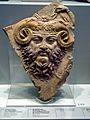
Roman cast terracotta of ram-horned Jupiter Ammon, 1st century AD (Museo Barracco, Rome).
-
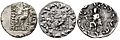
Evolution of Zeus Nikephoros ("Zeus holding Nike") on Indo-Greek coinage: from the Classical motif of Nike handing the wreath of victory to Zeus himself (left, coin of Heliocles I 145-130 BC), then to a baby elephant (middle, coin of Antialcidas 115-95 BC), and then to the Wheel of the Law, symbol of Buddhism (right, coin of Menander II 90–85 BC).
-
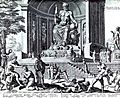
A statue of Zeus in a drawing.
-
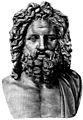
A bust of Zeus.


.jpg)


See also
 In Spanish: Zeus para niños
